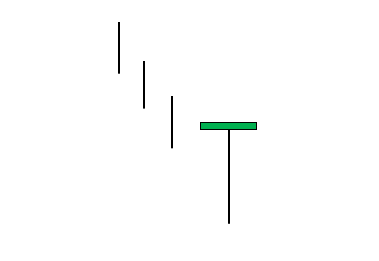
The Dragonfly Doji is a bullish pattern with a long lower shadow, little or no upper shadow and a doji forming at or near the bar high. Therefore, a Dragonfly Doji is a more restrictive version of the bullish hammer.
What is a Dragonfly Doji
First, the lower shadow indicates price rejection by being many times larger than the doji. The current bar’s range is above average and has a large lower shadow. The lower shadow is at least x times larger than the doji, by default a factor of 8. Finally, the current bar’s low marks a new N bar low, i.e. a swing strength definition, by default set to 5.
A Dragonfly Doji is identified in downtrends where the prior bar is a down-close or a small body bar. As for determining the current market bias, the candlestick indicator comes with an internal Swing Trend indicator. Deviation type, calculation period and deviation threshold is set via the indicator dialogue box.
The bearish equivalent to this pattern is the Gravestone Doji. However, being a one bar pattern these patterns are not particularly reliable without additional confirmation. One may therefore improve the statistical probability by combining with certain trend filters, such as a moving average and key support resistance levels such as the daily pivots. An example showing how to combine additional technical indicators with candlestick patterns available here.
Other bullish candlestick patterns
Other bullish candlestick patterns include the bullish belthold, bullish engulfing, bullish hammer, bullish harami, bullish harami cross, white marubozu, bullish piercing, inverted hammer, morning star, morning doji star, long white candle, tweezers bottom, three white soldiers and the rising three methods.
TheDragonfly Doji and the above patterns may be identified with our candlestick pattern indicator for NinjaTrader 8. Check out the LizardIndicators Premium Section for more information.