Introduced by Charles LeBeau, one of the first system traders, the Chandelier Stop, a.k.a the Chandelier Exit, takes the highest high from your entry position and deducts a multiple of the average true range to calculate the stop loss. Subsequently, the exit is moved up proportionally whenever a new high is made. Other than the below description, you may also review our Indicator Spotlight post on comparing the Chandelier Stop vs. the Chande Kroll Stop (with video).
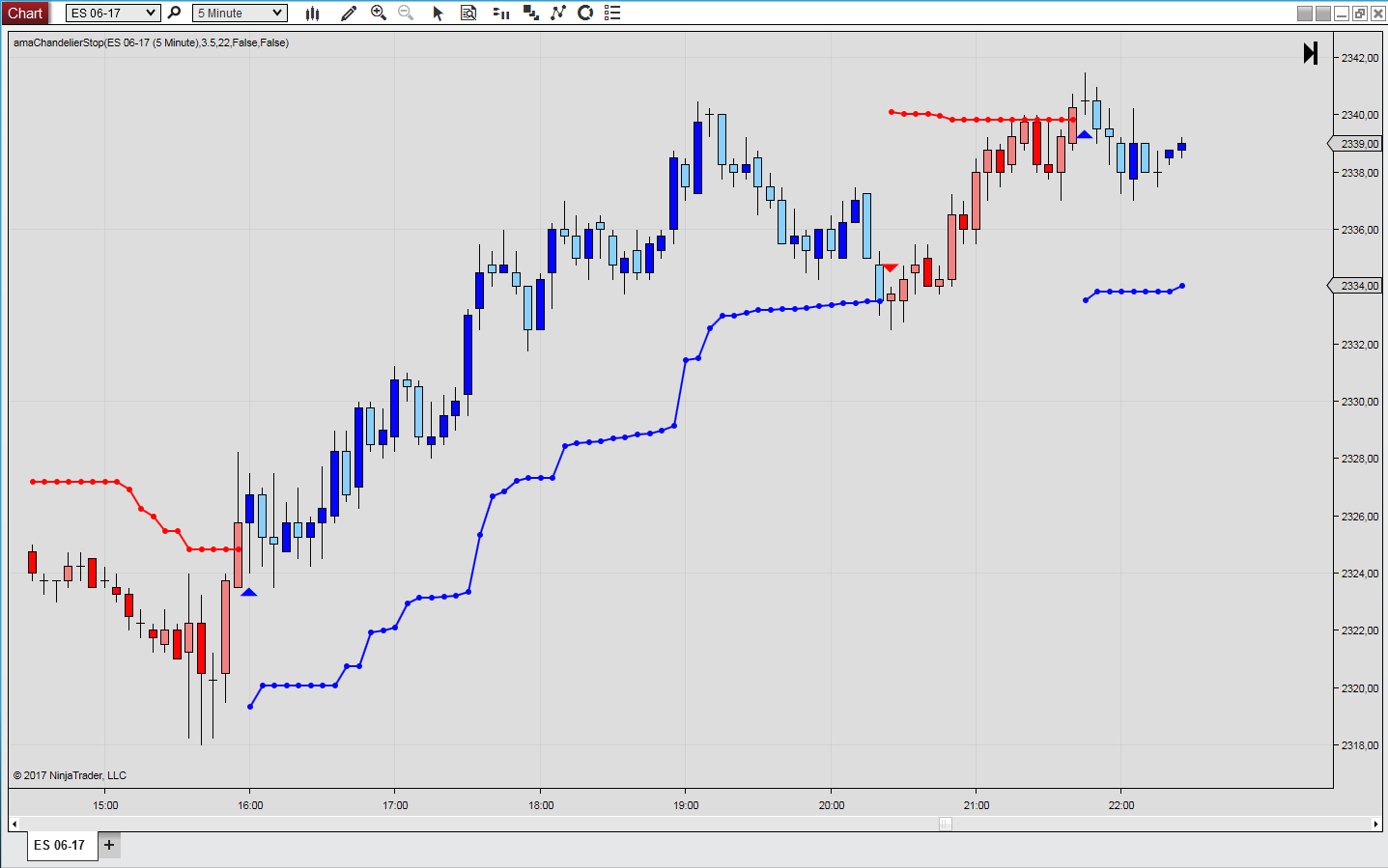
Indicator Description
A long position Chandelier Stop Loss takes the highest high from your entry and deducts a multiple of the average true range to calculate the stop level. One may see that for each new high, the stop line is moved up, protecting profits. Therefore, you will find the Chandelier Exit used in conjunction with trend following systems.
The Chandelier Stop Loss adjusts according to the current market volatility. This version of the Chandelier Exit also comes with the Donchian Anchor. For example, one may calculate a long stop by subtracting a multiple of the ATR from the lowest high. Conversely, you will add a multiple of the average true range from the highest low for short stops.
Chandelier Exit vs. Chande Kroll Stop
You may consider the Chandelier Stop a precursor to the Chande Kroll Stop. Whereas the Chandelier Exit applies “stop and reverse” signals, either being long or short, the Chande Kroll also distinguish between trend and sideways scenarios.
To compare the Chandelier Exit with the Chande Kroll Stop, first align the ATR settings for both indicators. Next, activate the “Donchian Anchor” and disable the Chandelier “Trailing Stop”. One may calculate a long stop by subtracting the ATR multiple from the highest high in the lookback period. Conversely, the short stop is located by adding the ATR multiple to the lowest low.
One may follow the same approach for the initial step of the Chande Kroll Stop calculation. To review, you may overlay the two indicators and set the Chande Kroll Stop ATR formula to “Wilder” (same calculation used for the Chandelier Exit). Finally, by selecting the Chande Kroll Stop reference period to “1”, the second step is eliminated, making it identical to the Chandelier Stop.
Other Library Indicators
Other than the Chandelier Exit, the following indicators are available from the trailing stop loss category: ATR Trailing Stop, Chande Kroll Stop, Deviation Stop, HiLo Activator, SuperTrend M11, SuperTrend U11 and the Wilders Volatility Stop.
Previous Indicator Spotlights have also reviewed the ATR Trailing Stop, SuperTrend and the Wilders Volatility Stop. Finally, you may also review a Spotlight discussing a trend following system using the Donchian Channel.
The Chandelier Exit is available for NinjaTrader 8.